Sperm Whales
PAMGuard - Detection Binaries & Databases
Full bandwidth recordings were run through a suite of click detectors in PAMGuard to pull out clicks corresponding to specific frequency bands. Each drifting acoustic recorder was run independently through PAMGuard. Click information was saved in binary files, while settings for the configuration were saved in a database.
PAMGuard settings files can be found here.
Binaries and databases can be found locally on the DON here “Z:/ANALYSIS/CalCurCEAS_2024/Sperm_whales”, and on the cloud here “pifsc-1-detector-output/drifting_recorder/1_Binaries-Database/2024_CalCurCEAS”
PAMpal - Acoustic Studies
Following PAMGuard processing, PAMpal was used to create acoustic studies for all detections in each drift. Using the binaries and databases from PAMGuard, the CalCurCEAS_drift-specific_Pm.Rmd R code was run for each drift, resulting in 4 .RData objects per drift.
- Acoustic studies can be found locally on the DON here “Z:/ANALYSIS/CalCurCEAS_2024/Sperm_whales/AcousticStudies”, and on the cloud here “pifsc-1-detector-output/drifting_recorder/2_Acoustic-Studies/2024_CalCurCEAS”
Event Summaries
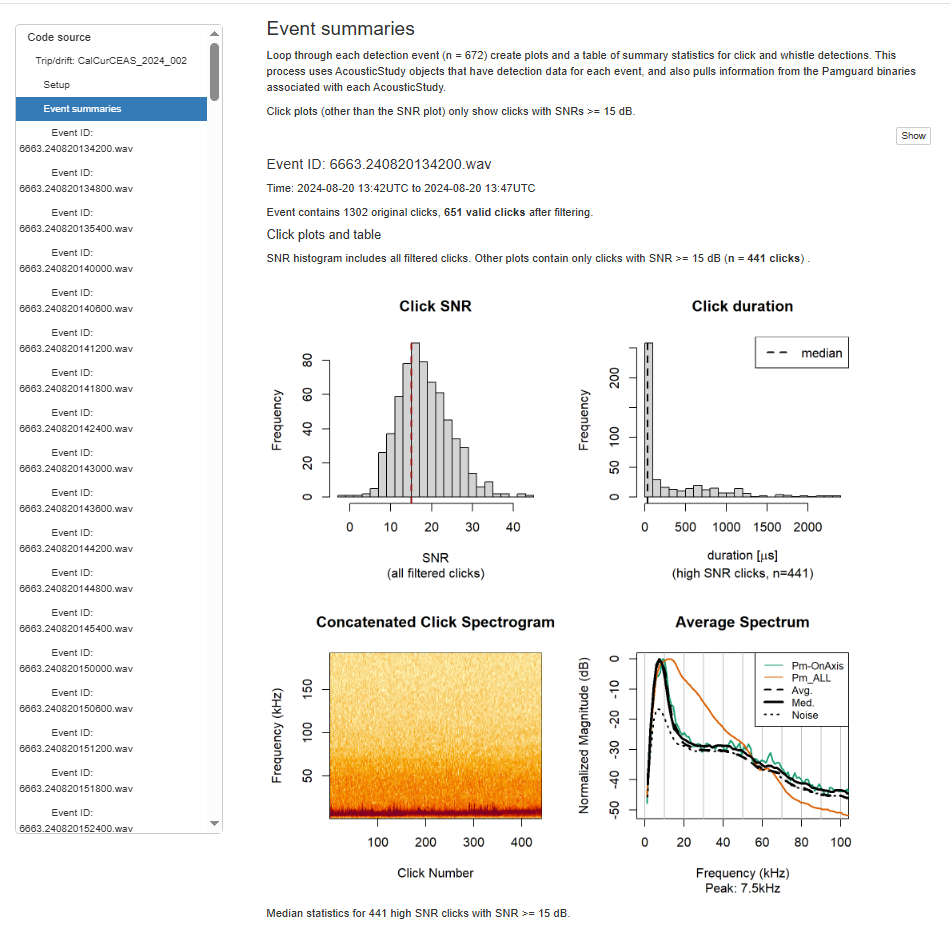
The next step was to create event summary reports for all potential sperm whale click events. The SpermWhale_event_summary_report_drifter.rmd and run_report.R code were run to produce an HTML of each potential event and an event table.
Event summary reports can be found;
Manual Validation
These events were manually validated (Jenny Trickey, PIFSC) using a Triton-based approach similar to methods used during the Adrift project, except without decimation. This manual analysis provides a list of wav files that contain sperm whales.
Summary reports (above) were unhelpful for unvalidated sperm whale events (the relatively generic spectral features of sperm whales made filtering the large numbers of false positives very difficult). The summary reports may be helpful if run post-classification and validation.
Links to datasets can be found on this github repository (SpermWhale_DASBR, CalCurCEAS data locations readme).
Status:
All data have been manually validated and will be analyzed by the SPACIOUS team for use in developing a statistical approach for population assessment using slowly moving PAM platforms (including drifting acoustic recorders).